NGO Storytelling: What It Is, Why It Works, and How to Get It Right
A lot of NGO campaigns are built on solid ground. You got the policy ask right. The data was solid, comms signed off on the messaging, and the campaign launched on schedule. Then the numbers came in. A few retweets from people who already agreed with you, a handful of donations from your usual donors, and from everyone else, not much.
People care about plenty of things. They queued around the block for a Labubu doll and scrolled past the latest UN climate report. The attention is there. So is the feeling. It just isn't, for the most part, attached to your cause.
That gap is rarely the audience’s fault. Most of the time, the story carrying the work simply hasn’t yet earned the feeling it deserves. That’s what NGO storytelling is for, and it belongs in campaign strategy from the beginning. Here’s what it is, why it works, and how to plan for it before the budget gets written.
What Is NGO Storytelling?
NGO storytelling, sometimes called impact storytelling, is the deliberate use of real people, places, or moments to move a specific audience toward a specific action on behalf of a cause. It works with a defined group of people, moved by a defined feeling, toward something they can actually do.
It shows up everywhere NGOs communicate. A scene in an animated explainer, a case study in a grant proposal, a 90-second campaign film, a testimonial in an annual report. And it reaches beyond fundraising. The same approach drives advocacy (contacting a representative), behaviour change (bringing a reusable container), and education, just as much as it drives donations.
A simple framework: WHO, FEEL, DO
Three questions, asked in order, do most of the work.
WHO do you need to reach? Picture a specific person, described in enough detail that you could almost write to them by name. A 35-year-old urban professional in Singapore who has never thought seriously about gender-based violence. A mid-level civil servant in Jakarta who handles environmental policy and feels cynical about real change. A first-time voter in Manila aged 18 to 25 who follows politics on TikTok but doesn’t show up to council meetings. If you can’t describe them this specifically, the story has no clear target.
FEEL. What do you need them to feel? Information rarely moves people to act on its own, which is why the feeling has to be chosen deliberately before the story is built. Not every strong emotion drives action, some move people forward, others produce avoidance or defensiveness before they ever reach your call to action. For a deeper look at which emotions work and why, see (link).
DO. What specific, measurable action do you need? It needs a verb and something you can count. Donate a recurring monthly amount. Vote for a specific bill at the next council meeting. Replace three single-use plastic items at home this month. Tell five friends and share the campaign material. “Raising awareness” is not an action. Pick something someone can actually do, and that you can measure.
Leave any one of these undefined and the story has no clear destination.
Applying for funding? We can help with the story. ✍️
If you're an impact organisation writing a grant proposal, our free tool builds the storytelling section for you. It helps you work out who you're trying to move, what you need them to feel, and the right animation style to get there, plus a costed budget, in about 10 minutes.
Benefits of Storytelling for NGOs and Nonprofits
The research on storytelling is worth knowing before you plan your campaign. Here is what past research actually shows.
It moves people to act in ways that statistics don't. In a 2007 Save the Children study by Small, Loewenstein, and Slovic, people who read about a single named girl, Rokia, donated significantly more than people shown statistics about the same food crisis. More surprisingly, combining her story with the statistics actually reduced donations. Analytical thinking seemed to get in the way of giving.
Large numbers stop moving us, and there's a name for why. Paul Slovic calls it psychic numbing. The more people affected by a crisis, the less we feel it. We respond to one identifiable person, and go emotionally numb in front of numbers, even when those numbers represent far greater suffering. A story with a face cuts through in a way that scale alone cannot.
It puts the listener inside the experience. Princeton neuroscientist Uri Hasson found that when someone tells a real story, the listener's brain activity begins to mirror the speaker's. The two brains essentially synchronise, and the listener starts to relive the experience alongside the person telling it. That kind of connection runs deeper than reading a fact.
It sticks. Research shared by Stanford's Jennifer Aaker found that stories are remembered up to 22 times more than facts alone. In one widely cited study, only 5% of an audience recalled a statistic afterwards, while 63% remembered the stories. (Source)
None of this works if storytelling is treated as decoration added after the strategy is set. By the time most teams think seriously about it, the budget is already locked. It gets priced out, or becomes leftover spend before a deadline, and either way it underperforms. Plan for it at the same stage as your theory of change.
Seeing WHO, FEEL, DO at Work
At ROUGE Collective, we've had the chance to apply this framework across campaigns in Malaysia and beyond. Here is what it looks like in practice.
Sang Kancil and Sustainable Tourism, made with The Habitat Foundation, reimagines the beloved Malaysian folk character as the face of a sustainable tourism campaign. It’s a series of short animated pieces that weave behaviour-change messaging into a story audiences already know and love.
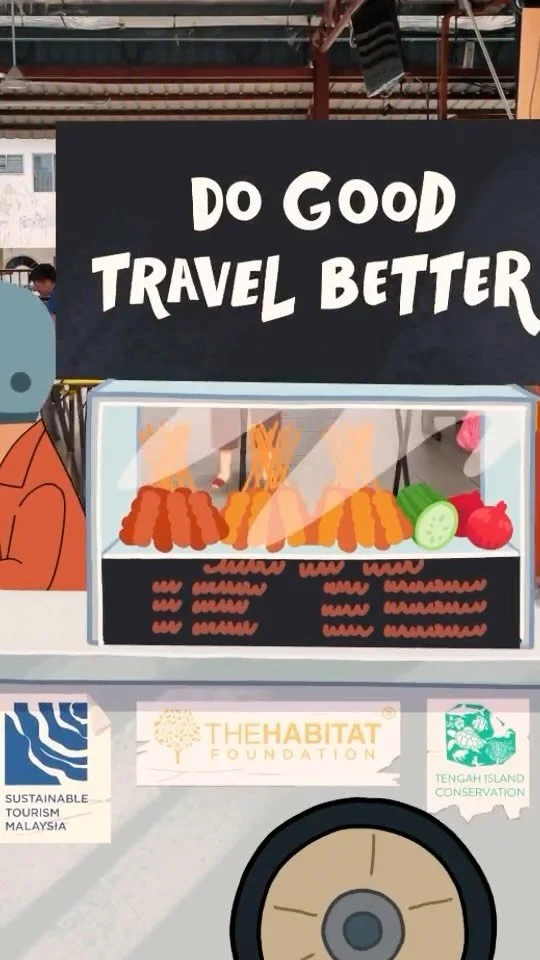
The WHO: Malaysians who regularly buy from neighbourhood kuih and market stalls.
The FEEL: Elevation → Inspiration. They love the kuih and the people who make it, but the plastic feels like one of those things no single customer can fix. Then they watch ROUGE do the one small thing that actually is in a customer's hands, bringing your own box, and think: I could do that too.
The DO: Bring your own container the next time you visit a kuih stall.
Turn Your Answers Into a Proposal Draft
You've now got the same three questions a production studio works from: WHO, FEEL, DO. The harder part is turning those answers into something you can put in front of a funder.
That's what the Grant Proposal Maker does. It's built around the same framework, including a feelings wheel that helps you land on the right emotion and understand why some feelings work against the action you're trying to drive. Answer the questions, and it builds out the storytelling section of your proposal. If you'd rather think it through with someone first, book a free 30-minute call and we'll work through WHO/FEEL/DO with you before you commit anything to paper.
FAQs
What is impact storytelling?
Impact storytelling is the deliberate use of real people or situations to move a specific audience toward a specific action on behalf of a cause. It's used across NGOs, nonprofits, and social enterprises to drive donations, advocacy, and behaviour change. At its core, it's a strategy decision first, and the content format follows from that.
Why is impact storytelling important for advocacy, not just fundraising?
The same psychology applies whatever the action is. People respond to identifiable individuals and specific feelings regardless of what they're being asked to do next, and that's why the framework behind a fundraising film and an advocacy campaign is the same.
How much does impact storytelling or animation actually cost?
It depends on production style and length, but the figures are knowable upfront. The Grant Proposal Maker costs a draft out in your own currency based on the deliverables you choose, so you have a real number before you write the proposal.
Do I need video or animation, or can a written story work?
A written case study built on WHO/FEEL/DO works. Video and animation extend reach and cross language barriers more easily, and the framework is what makes a story effective regardless of medium.
Sources:
Small, D. A., Loewenstein, G., & Slovic, P. (2007). Sympathy and callousness: The impact of deliberative thought on donations to identifiable and statistical victims. Organizational Behavior and Human Decision Processes, 102(2), 143–153.
Slovic, P. (2007). “If I look at the mass I will never act”: Psychic numbing and genocide. Judgment and Decision Making, 2(2), 79–95.
Ganz, M. (2011). Public Narrative, Collective Action, and Power. In Accountability through Public Opinion: From Inertia to Public Action. Washington, DC: The World Bank.
Aaker, J. Stanford Graduate School of Business — “Stories are remembered up to 22 times more than facts alone.”